A retelling of the Katha Upanishad — for the restless, the curious, and the cosmically bewildered
The Story: A Child with Terribly Inconvenient Questions
There are children who ask embarrassing questions at dinner parties, and then there is Nachiketa — a boy who asked the most embarrassing question of all, to the most dangerous audience imaginable. His father, the sage Vajashravas, was performing a grand sacrifice, giving away his possessions to earn religious merit. The only problem: the possessions he was donating were old cows, blind in one eye, lame in various legs, and well past their productive years. They were, in the most polite terms, cosmically useless gifts.
Young Nachiketa, watching this spectacle with the sharp eyes of a child who has not yet learned the adult art of looking away, tugged his father's robe and asked, with devastating simplicity: "Father, to whom will you give me?" It was not impudence. It was philosophy disguised as a question about livestock logistics.
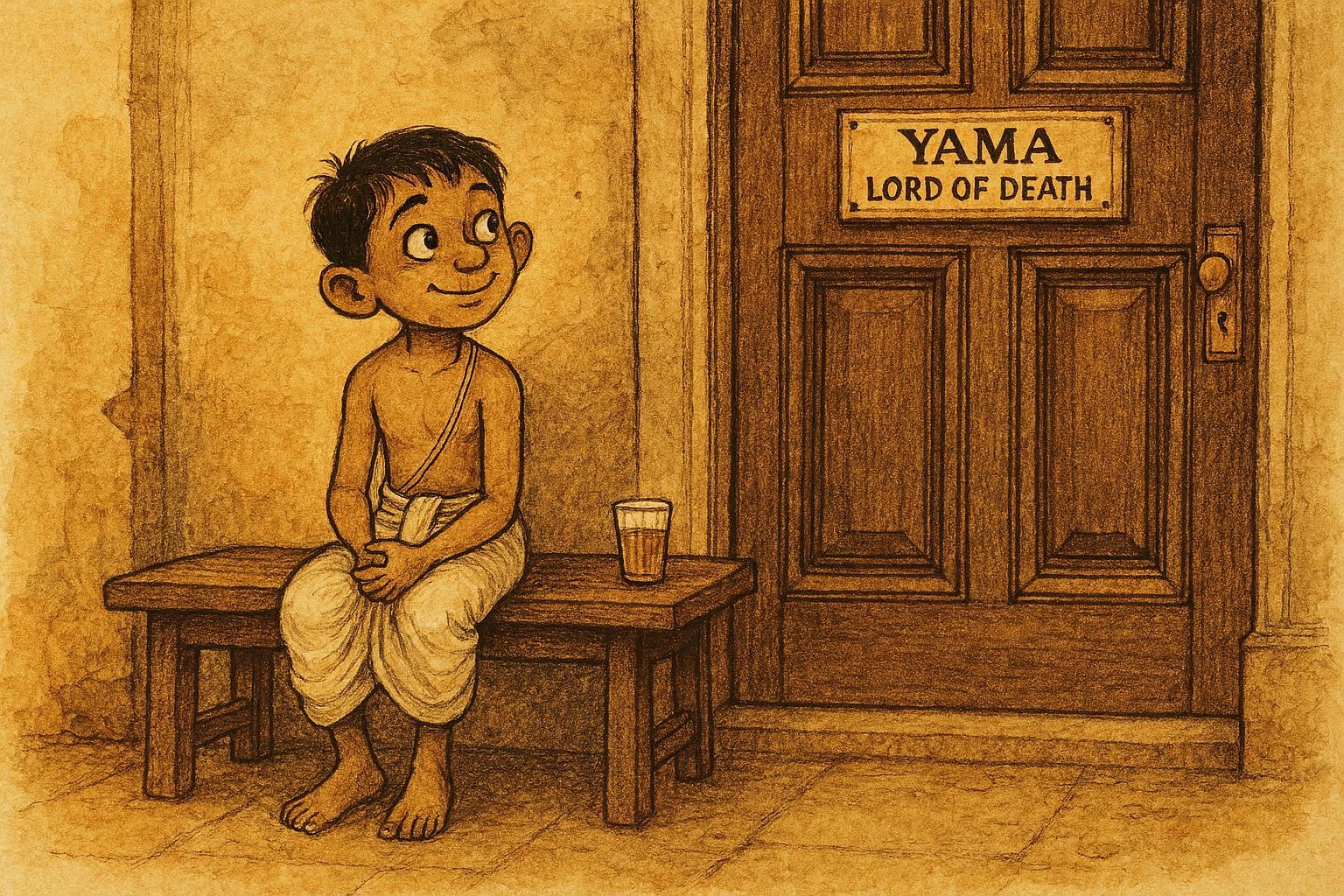
Vajashravas, who clearly needed more patience than his sacrifice was generating, snapped: "To Death I give you!" — the ancient equivalent of sending a child to his room, except the room happened to be the House of Yama, Lord of Death himself. Most children would have burst into tears. Nachiketa packed his resolve and walked straight to Yama's door.
He knocked. Yama, being the Lord of Cosmic Order, was away on business for three days. Nachiketa waited. He did not eat. He did not complain. He simply sat — which is quite remarkable for any child, and particularly remarkable at the doorstep of Death.
When Yama returned, he was so impressed — and so embarrassed by the breach of hospitality — that he offered Nachiketa three boons. The first two were straightforward: peace with his father, and the secret of a sacred fire ritual. But the third wish is the one that has rattled philosophers ever since.
"There is this doubt about a man who is dead — some say he exists, others say he does not. I want to know the truth of this. This is the boon I ask."
— Katha Upanishad, 1.1.20
Yama tried everything. He offered wealth, kingdoms, beautiful pleasures, celestial delights, long life, elephants, gold — the full divine catalogue. "Ask for anything else, Nachiketa," he pleaded, with the desperation of a man who knows he is about to lose an argument to a teenager. Nachiketa refused, politely but absolutely. And so Yama, outnegotiated by a schoolboy, sat down and taught him the deepest secret of existence: the nature of the Atman — the eternal Self, which is neither born nor dies, which no sword can cut, no fire burn, no water wet.
The lesson was not merely about death. It was about what survives it — and more importantly, how one should live in the full knowledge of impermanence.
The Core Philosophy: Ethics at the Edge of the Abyss
What makes Nachiketa genuinely heroic is not that he marched to Death's kingdom — plenty of mythological heroes have done that, usually with swords and companions. Nachiketa went alone, unarmed, and sat there on principle. He had one question and he would not be bought off from it.
The Katha Upanishad draws a razor-sharp distinction between two paths: Shreyas (what is good and enduring) and Preyas (what is pleasant and immediate). Yama's parade of temptations — the gold, the kingdoms, the pleasures — were all Preyas. They glittered. They beckoned. They were, in the end, just well-dressed distractions from the one question that mattered.
Nachiketa's moral courage is the ethics of the Upanishad made flesh: choose the difficult truth over the comfortable lie. Be honest about what you value, even when — especially when — someone very powerful is trying to talk you out of it. His father gave him away in a moment of irritation; Yama tried to purchase his silence with gifts. Nachiketa was unmoved by both, which puts him in exceedingly rare company.
The deeper moral architecture here is accountability. Vajashravas was offering defective cows and calling it virtue. Nachiketa simply pointed this out — and accepted the consequences, even if those consequences involved a rather extended stay near the underworld. This is dharma in its purest, most inconvenient form: tell the truth, bear the cost, wait patiently for the outcome. It is also, incidentally, the perfect description of what it feels like when Saturn pays you a visit.
The Astrological Connection: Yama, Time & the Great Saturn
In the Vedic cosmos, Yama is not simply Death. He is Dharmaraja — the King of Righteousness, the lord of cosmic reckoning, the being who keeps meticulous accounts of every action, word, and intention. He is, in other words, ♄ SHANI given a name and a magnificent throne.
Shani — Saturn — is Yama's elder brother in some traditions, or his cosmic counterpart in others. Both are associated with Kala (Time), with karma, with the slow, grinding, utterly impartial machinery of consequence. Saturn does not hate you. He simply insists on the truth, exactly as Yama insisted on it with Nachiketa. He will sit in your chart, transit through your houses, and refuse to be bribed with pleasant rationalizations or soothing gemstones worn without genuine self-reflection.
When Saturn transits a significant house in your natal chart — particularly during Sade Sati, his seven-and-a-half-year passage through the Moon sign and its neighbouring signs — astrologers across the centuries have described it in terms that would make even Nachiketa shift his seating position. Delays. Burdens. A systematic stripping away of the inessential. The cosmic equivalent of sitting outside Death's door for three days with no food, no WiFi, and no clear indication of when the door will open.
Saturn transits are not punishments. They are Yama asking, with great patience and very little small talk, which boons you actually intend to spend your life pursuing.
— Vedic Astrological Tradition
When Saturn transits the 1st house, it renegotiates your identity from the ground up. The 4th house: your sense of home and safety is placed under review. The 7th: partnerships are examined with the thoroughness of a tax audit. The 10th: career and reputation are stress-tested until only what is genuinely solid remains. In each case, the method is Yama's method — slow, thorough, absolutely fair, and deeply uncomfortable to those who have been postponing the important questions.
The Nakshatra of Magha, ruled by the ancestral spirits called the Pitrs, connects directly to this lineage of Yama-as-reckoner. When significant planets transit Magha, there is often a call to face one's legacy, one's karmic debts. Nachiketa's story is, at its heart, a Magha story: a young soul reckoning with inheritance, facing the ancestor of all ancestors, and emerging — slowly, after waiting — profoundly wiser.
Practical Takeaway: Being Nachiketa in 2026
We live in a world that has elevated Preyas to an art form. The notifications, the dopamine loops, the endless scroll — all of it is Yama offering kingdoms and elephants, hoping we will forget that we had a real question somewhere. We did. We still do. And unlike Nachiketa, most of us have not yet knocked on the door.
Here, then, are four Nachiketa-tested, Yama-approved practices for navigating the year 2026 with something resembling spiritual dignity:
- Name the question you keep avoiding. Nachiketa's power lay not in his fearlessness but in his absolute clarity of purpose. He knew exactly what he wanted to know. Sit somewhere quieter than your notification bar and write — actually write — the one question about your own life you have been purchasing distractions to avoid. That question is your Saturn transit, already in progress whether you acknowledge it or not.
- Audit your offerings. Vajashravas gave blind, lame cows and called it generosity. We do this too — with our attention, our time, our commitments — offering our worst to the things we claim to cherish most. Ask honestly: what am I actually giving to the people and purposes I love? Is it the best I have, or the portion I can spare without any real sacrifice?
- Wait with intention. Nachiketa waited three days at Death's door without food or complaint. In 2026, we struggle to wait three minutes for a video to buffer. If Saturn is transiting a difficult house in your chart right now, consider seriously that the waiting is the lesson — not the prelude to one. Patience exercised consciously becomes wisdom accumulated quietly, in the manner of interest in a very slow, very reliable bank.
- Separate Shreyas from Preyas — daily. At the end of each day, ask: what did I choose because it was genuinely good, and what did I choose because it felt immediately pleasant? No judgment required. Just clarity. Practised consistently, this single question restructures a life more thoroughly than any resolution made in January and abandoned by the second Tuesday of February.
Saturn will finish his transit eventually. Yama always releases the worthy ones. But what Nachiketa carried back from Death's door was not merely a reprieve from mortality — it was the living knowledge of what is real and what is not. In a year saturated with very convincing fictions, that knowledge is, if you will permit the expression, priceless.
The Atman cannot be known through much learning, nor through the intellect, nor through much hearing. It is known by the one whom it chooses — to such a one, the Atman reveals its true nature.
— Katha Upanishad, 1.2.23
Saturn is not your enemy. He is the examiner who refuses to grade on a curve, the teacher who will not pass you until you have genuinely understood the lesson. Sit at his door patiently — honest, persistent, unwilling to be distracted by pleasant alternatives — and he will, in his own unhurried and thoroughly inconvenient time, give you precisely what you came for.
May your Saturn transits be illuminating, your boons be wisely chosen, and your cows — should you ever offer any — be in robust and unimpeachable health.
Reflections (1)
A very interesting narrative, indeed and a timely one too.
Share Your Reflection