It is a well-documented tragedy of parenting that you can send a perfectly pleasant twelve-year-old away to receive the finest education available, only for them to return at twenty-four as a completely insufferable intellectual.
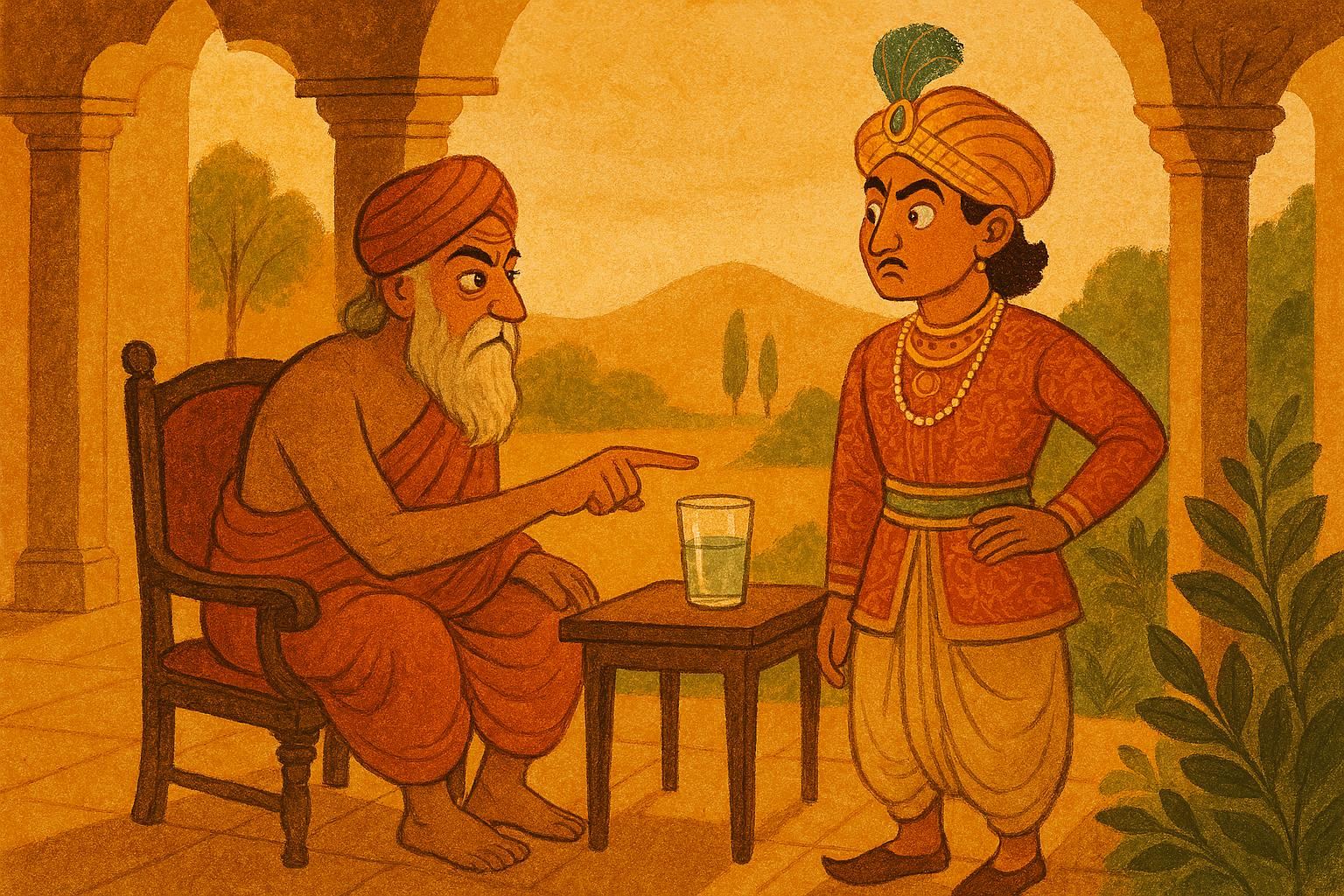
Thousands of years ago, the sage Uddalaka Aruni experienced this exact phenomenon. He had sent his son, Svetaketu, to a prestigious forest gurukul to study the Vedas. For twelve years, Svetaketu memorized chants, mastered rituals, and debated cosmic law. When he finally walked back into his father’s courtyard, he did not walk with the quiet grace of a spiritually awakened being. He walked like a man who expects to be handed a microphone.
Svetaketu had acquired what modern universities call "a 4.0 GPA" and what ancient sages called "a massive, highly flammable ego." He greeted his father with a look of polite condescension, fully prepared to correct the old man’s grammar.
Uddalaka took one look at his son’s swollen head and sighed the heavy sigh of a father who realizes his tuition money has been spectacularly misspent.
He decided an intervention was necessary.
"Svetaketu," Uddalaka said mildly, "You seem very proud of your immense learning. But tell me, did your teachers happen to teach you that one rule by which the unhearable becomes heard? By which the unseeable becomes seen? By which the unknowable is known?"
Svetaketu blinked. He ran a quick mental search through his twelve years of rigorous data collection. "I’m sorry, what?" he asked, his arrogance momentarily slipping. "Is there a rule like that? My teachers must not have known it, otherwise they surely would have taught it to me. Please, father, explain it."
Uddalaka did not give him a lecture. He gave him chores.
"Bring me a fruit from that banyan tree," the father ordered.
Svetaketu fetched it.
"Break it open. What do you see?"
"Tiny seeds, father. Exceptionally tiny."
"Break open one of the seeds. What do you see inside it?"
Svetaketu squinted. "Absolutely nothing, father."
Uddalaka smiled. "My dear boy, from that 'absolutely nothing' which you cannot see, this massive banyan tree grows. Now, take this salt, put it in a bowl of water, and bring it to me tomorrow morning."
The next day, Svetaketu returned.
"Bring me the salt you put in the water," Uddalaka said.
Svetaketu looked in the bowl. "I can't. It has dissolved."
"Sip from the surface. How does it taste?"
"Salty."
"Sip from the middle. Sip from the bottom. How does it taste?"
"It is salty everywhere, father."
Uddalaka leaned forward, finally delivering the most famous punchline in the history of human thought.
"Just like the salt, the essence of the universe is dissolved into everything. You cannot see it, but it is there. It is the only reality. And Svetaketu," the father paused, "Tat Tvam Asi."
Thou art that.
You are not the scholar. You are not the body. You are the invisible salt. You are the universe itself.
The Numerology of the Singularity: The Two Faces of Number 1
This encounter from the Chandogya Upanishad is not just an ancient method for deflating a teenager’s ego; it is the absolute foundation of Vedic Numerology, specifically regarding the Number 1 and its planetary ruler, the Sun (Surya).
In numerology, 1 is the Alpha. It is the singularity from which all other numbers (and all other forms) emanate. But the Number 1 carries a dangerous dual nature, perfectly illustrated by Svetaketu’s journey.
When Svetaketu returned from school, he was embodying the Lower Octave of Number 1. This is the Sun operating entirely as Ahamkara (the Ego). The lower Number 1 is obsessed with separation. It says, "I am the first. I am unique. I am the smartest in the room. Look at me." It is the blinding glare of the midday Sun that forces everyone to look away.
Uddalaka’s salt experiment was an initiation into the Higher Octave of Number 1. This is the Sun operating as Atman (the Universal Soul). The higher Number 1 understands that there are not actually billions of separate ones running around the planet. There is only The One. The Singularity. The salt in the water.
When you truly understand the higher vibration of the Number 1, the desperate need to prove your individuality collapses. Why would you exhaust yourself trying to prove you are a special, unique drop of water when you have just realized you are the entire ocean?
The Modern Burden of Being Special
We live in an era that worships the Lower Octave of Number 1.
By the time we are adults in 2026, we have spent years acting like Svetaketu at the gurukul. We painstakingly construct our uniqueness. We curate our personal brands on social media, we optimize our LinkedIn profiles, and we exhaust ourselves attempting to prove that our specific combination of career, hobbies, and opinions makes us highly distinct from the eight billion other people on Earth.
We suffer from a terrifying modern delusion: we believe that if we are not categorically separate and superior, we do not exist.
The philosophy of Tat Tvam Asi offers a devastatingly simple exit from this exhausting treadmill. It suggests that the relentless pursuit of "standing out" is a cosmic joke, played on us by our own egos. It is the banyan seed loudly declaring it has nothing to do with the banyan tree.
It turns out that the universe is not a massive corporate ladder where you must desperately fight to become Number One. It is simply a glass of water.
We spend decades acquiring degrees, titles, and highly refined anxieties, desperately trying to prove we are the most important object in the room. And yet, millennia later, the grand cosmic reality remains entirely unbothered by our resumes -- waiting patiently for us to realize that we are just a pinch of salt, completely and beautifully dissolved in the whole.

Reflections (0)
Be the first to share your thoughts.
Share Your Reflection