It is a truth universally acknowledged in ancient India that when a man decides to give up the material world and retreat to the forest, he leaves behind a tremendous amount of administrative paperwork for his family.
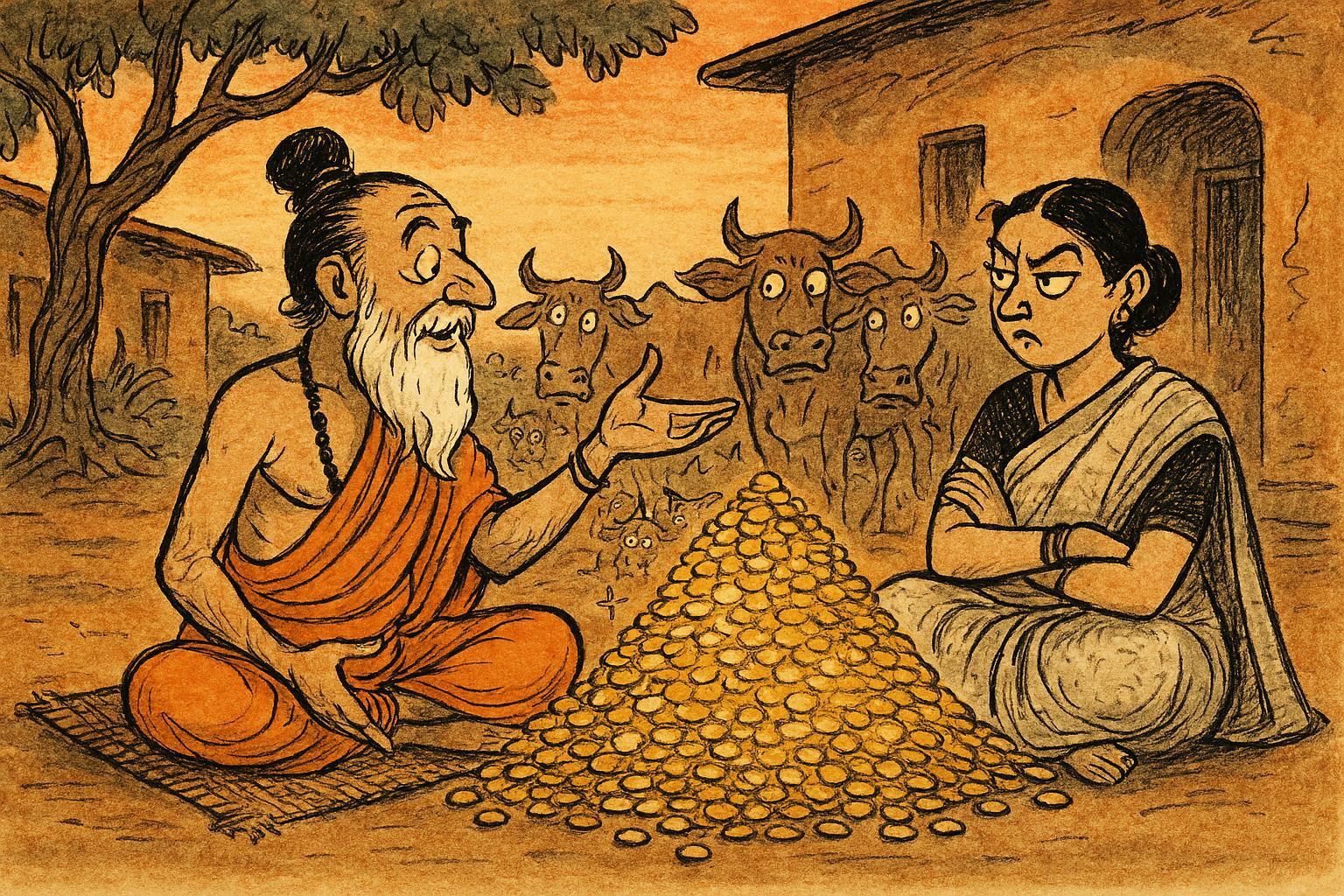
Take Sage Yajnavalkya, for example. He was not just any sage; he was the undisputed intellectual heavyweight champion of his era. In those days, being a top-tier philosopher didn't get you a book deal or a verified social media checkmark. It got you livestock. Thousands of them. Whenever Yajnavalkya destroyed a rival priest in a royal debate, the King would reward him with hundreds of cows, each with ten grams of gold awkwardly tied to their horns by highly stressed palace interns.
Consequently, Yajnavalkya was absurdly rich. But managing this was a nightmare. Do you know how hard it is to tie gold to a cow without it eating the string?
One Tuesday, having realized that there is only so much one can do with several thousand glittering bovines, the great Sage decided he had had enough. He announced he was entering Sannyasa - the final stage of life, where one wanders the forests in search of ultimate liberation, conveniently leaving the property taxes behind.
Before leaving, he called his two wives to settle his estate.
His first wife, Katyayani, was the Chief Financial Officer of the household. She possessed the kind of grounded realism that keeps society from collapsing. If a cow sneezed two villages away, Katyayani knew exactly how it would affect the quarterly milk yield. If you gave her a gold coin, she could instantly calculate its market value against a bag of rice.
His second wife, Maitreyi, was a different entity altogether. She was a "Brahmavadini" - a philosopher in her own right. While Katyayani worried about the grocery inventory, Maitreyi was prone to pausing mid-breakfast to ask a piece of fruit what its true cosmic purpose was.
The Ultimate Financial Settlement
Yajnavalkya sat Maitreyi down. He was probably expecting a few tears, or at least a mild argument over who got the better grazing lands.
"My dear," he said grandly. "I am leaving the householder life. I wish to make a final settlement between you and Katyayani. I am splitting my vast fortune perfectly in half."
He expected tears, or perhaps a mild argument over who got the better grazing lands.
Instead, Maitreyi looked at the mountain of gold, then at the mooing cows, and then at her husband. She raised one highly skeptical eyebrow. And then asked a question that essentially brought the entire Brihadaranyaka Upanishad to a screeching halt.
"My lord," she said, her voice dripping with terrifying logic, "If this entire earth filled with wealth were to belong to me alone, would I become immortal by it?"
Yajnavalkya, caught entirely off guard by his wife’s supreme lack of interest in real estate, jerked slightly. He had to be honest. "No," he sighed. "Your life would be exactly like the life of very rich people. You will live comfortably, complain about the domestic help, and eat very well. But there is absolutely no hope of immortality through wealth."
Maitreyi delivered the ancient equivalent of a mic-drop.
"Yenaham namrtasyam kim aham tena kuryam?" she asked. (What should I do with that by which I do not become immortal?)
"Give the cows to Katyayani," she added. "But, tell me the secret of what you are actually looking for."
Yajnavalkya's face lit up. Nothing delights a philosopher more than someone asking for a lecture instead of a lump sum. He pulled her close and delivered one of the greatest discourses in human history: We do not love our spouses, our wealth, or our children for their own sake. We love them because the Divine Self (Atman) resides within them.
The Astrological Connection: The War of the Gurus
To understand the sheer gravity of Maitreyi’s choice, we must look at the sky. In Vedic Astrology, this exact negotiation happens in your birth chart every single day. It is the eternal tug-of-war between two massive planetary forces: Venus (Shukracharya) and Jupiter (Brihaspati).
Both are "Gurus" (Teachers), but they teach very different curriculums.
Venus is the guru of the material realm. Venus governs your bank accounts, your aesthetic Instagram feed, your luxury cars, your aesthetics, your romantic comforts, and the very human desire to just have a really, really nice time on Earth. Venus is Katyayani’s domain. It is practical, beautiful, and necessary. Venus remembers to moisturize.
Jupiter, however, is the guru of the gods and the realm of Dharma. Jupiter governs higher wisdom, cosmic law, and the expanding of the soul. Jupiter is Maitreyi. Jupiter doesn't care if you are wearing the same unwashed jeans for a week as long as you are contemplating the Infinite.
When people have a strong Venus, they accumulate things. But as Yajnavalkya admitted, “Your life will just be like the life of rich people.” Venus can make you a cage made of gold, but it cannot unlock the door.
When you run a Jupiter period (Mahadasha), or when Jupiter strongly influences your chart, you suddenly experience the "Maitreyi Trigger." You look at your job, your paycheck, your wardrobe, and your accumulation of stuff, and your soul rudely interrupts your shopping to ask: "Yes, but will this make me immortal?"
Astrology doesn't say Venus is bad. We need Venus to function in society. But the ultimate tragedy of the human chart occurs when a person serves their entire life serving Venus, completely forgetting to invite Jupiter to the party.
Practical Magic for 2026
If you log onto social media today, you will find millions of modern-day Yajnavalkyas chasing the 2026 version of gold-horned cows: Crypto wallets, startup valuations, and the FIRE (Financial Independence, Retire Early) movement.
We hustle endlessly under the illusion that if we just hit a certain net worth, we will finally be immune to the miseries of life. We believe wealth will buy us a psychological immortality.
Maitreyi’s 3,000-year-old question is the ultimate financial audit for the modern professional.
How do you apply this today?
-
The 'Enough' Metric: Do not reject wealth (even Yajnavalkya enjoyed it for decades before getting bored). But clearly define what is enough for your Katyayani-side (your practical needs).
-
Audit your Ambition: The next time you are burning yourself out for a 5% raise, a luxury watch, or a bigger house to impress neighbors you don't even like, pause. Ask yourself: What should I do with this if it does not feed my soul?
-
Invest in Jupiter: Spend at least a fraction of your weekly time on things that have zero financial ROI. Read a dense philosophy book, sit in silence, help a stranger, or learn a sacred text.
True wealth isn't the ability to buy whatever you want. As Maitreyi proved, true wealth is the ability to look at everything the world has to offer, raise one eyebrow, and say, "Is that all you've got?"


Reflections (0)
Be the first to share your thoughts.
Share Your Reflection