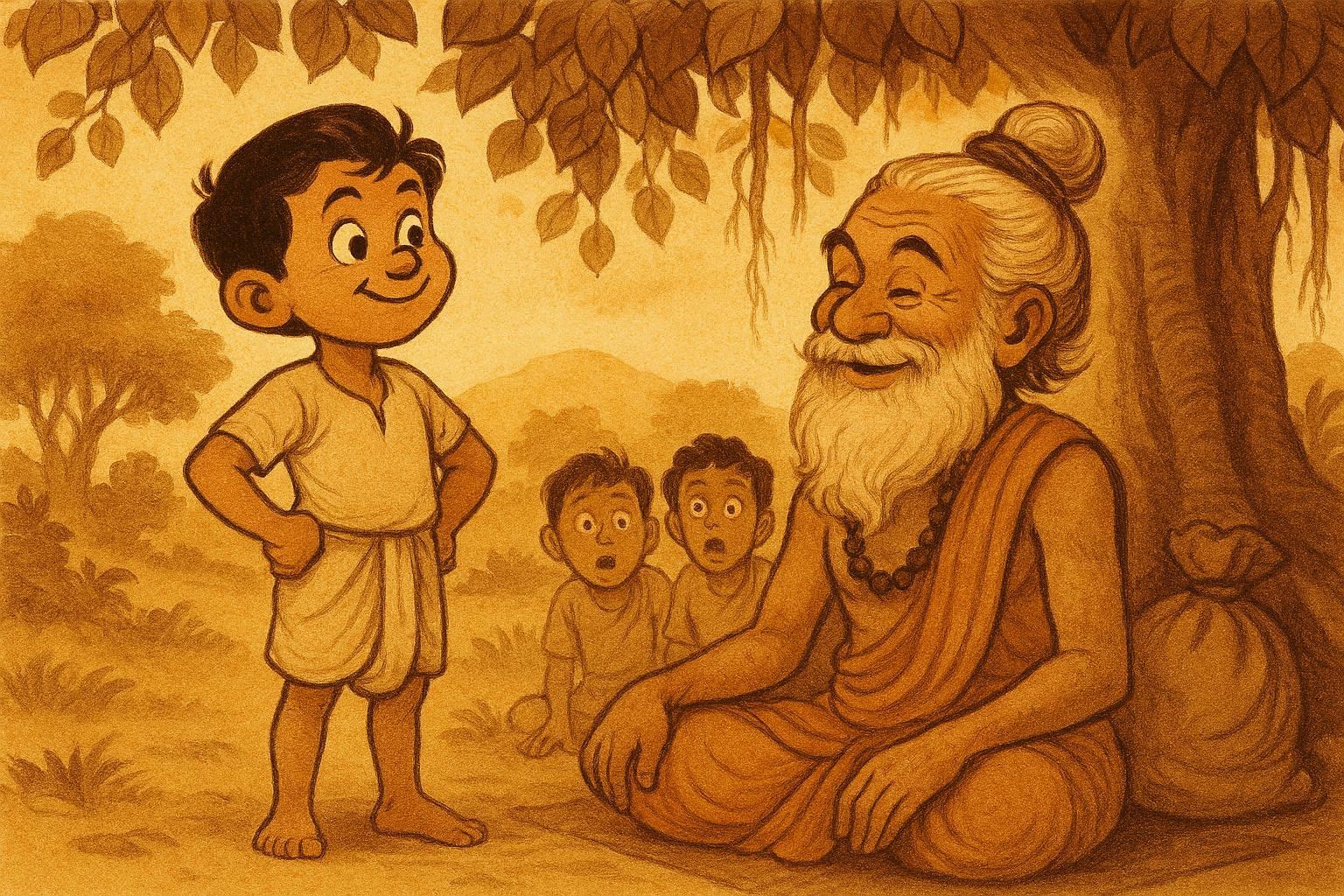
In the ancient days, gaining admission to a prestigious forest ashram was remarkably similar to getting into an elite university today. You needed a sharp mind, an agonizingly pure character, and—most importantly—a highly impressive family tree.
If you could not recite the names of your father, your grandfather, and that one great-uncle who once handed a glass of water to a minor deity, the admissions committee generally asked you to leave.
Enter our hero: a young, earnest boy named Satyakama.
Satyakama desperately wanted to study the mysteries of the universe. He had his eye on the ashram of Sage Gautama Haridrumata, the most distinguished teacher of the era. There was just one tiny administrative hiccup: Satyakama did not know his "gotra" (lineage).
Being a sensible boy, he went to the one person who usually knows these things. He asked his mother, Jabala.
"Mother," he said, "I am off to seek the ultimate truth of the cosmos. But first, what is my family lineage?"
Now, Jabala was not a wealthy woman. She had spent her youth working as a maidservant in various households, scrubbing floors and serving guests. She did not have the luxury of maintaining a family diary.
With a refreshing lack of public relations spin, Jabala looked at her son and said, "My dear, I was a servant. I moved from place to place. I met many people. To be entirely honest with you, I have no idea who your father is. My name is Jabala. Your name is Satyakama. Just tell the Sage you are Satyakama Jabala."
Imagine the scene. It is as if a student today walked into a Harvard interview and, when asked for his parents' alumni connections, proudly presented a grocery receipt.
The Admissions Interview
Armed with this devastatingly unhelpful information, Satyakama walked into Sage Gautama’s ashram. The courtyard was filled with aristocratic students, all adjusting their sacred threads and comparing the spiritual credentials of their ancestors.
Gautama looked at the boy. "Welcome, child. What is your lineage?"
The courtyard fell silent. Everyone leaned in to hear the grand pedigree of the newcomer.
Satyakama stood incredibly straight and said, "Sir, I asked my mother. She said she was a servant who moved around a lot in her youth, and she has no idea who my father is. She told me to just say I am Satyakama, son of Jabala. So, that is who I am."
The aristocratic students gasped. A few probably fainted from the sheer scandal of it. They waited for Sage Gautama to summon the ancient equivalent of security and have the boy thrown out.
Instead, the old Sage’s eyes lit up. He smiled—a rare event that usually terrified his senior students—and stood up to embrace the boy.
"Bring the sacred fuel for the fire, my boy!" Gautama declared. "I will accept you. No one but a true seeker of Brahman (the Ultimate Truth) would have the courage to speak such naked, unapologetic truth. Your lineage is not defined by your blood; it is defined by your honesty."
And with that, Satyakama the fatherless boy became Satyakama the Brahmin, eventually growing into one of the greatest enlightened sages in the Upanishads.
The Astrological Mechanics: Why Jupiter Beats the Sun
This story from the Chandogya Upanishad is not just a charming tale of ancient egalitarianism. It contains a massive, hidden astrological secret.
In Vedic Astrology, your lineage, your genetics, and the "royal favors" of your birth are seen through the Sun (Surya) and the Moon (Chandra). They represent your father and mother. If your Sun is weak or afflicted in your chart, classical texts might doom-scroll your life, predicting a lack of support, poor heritage, or a "disadvantaged starting line."
But the Upanishads disagree. And so does the deeper layer of astrology.
There is one planet capable of overriding your genetics, your upbringing, and your societal status: Jupiter (Brihaspati).
Jupiter is the planet of Dharma, higher wisdom, and—above all—Truth. When Satyakama stood in that courtyard and refused to lie, he wasn't relying on his Sun (which was unknown). He was activating his Jupiter.
A strong Jupiter in a birth chart does not care if you were born in a palace in Delhi or a small flat in Amsterdam. It operates on the cosmic law that Truth is the highest vibration. When you align yourself with the absolute truth, you instantly connect to the lineage of the universe itself. You are no longer governed by the DNA of your parents; you are governed by the gravity of your principles.
Practical Magic for 2026
We live in a world obsessed with "personal branding." We curate our online lives, desperately hiding our flaws, our humble beginnings, or our messy family histories. We spend immense energy pretending to be people who have their lives perfectly figured out.
Satyakama Jabala is the ultimate patron saint of the "Imposter Syndrome" cure.
How do we apply his story today? By practicing Radical Honesty.
- In your career: The next time you don't know the answer in a meeting, do not bluff. Try saying, "I don't know the answer to that, but I will find out." The sheer shock of an honest employee is often enough to impress any modern-day Sage Gautama.
- In your relationships: Stop pretending you do not have baggage. Own your history. "I am a bit messy, I have a weird past, but I am here to learn."
- In your spiritual life: You cannot trick the universe. The planets see right through your PR campaign.
When you stop expending energy to hide your "unimpressive" origins, that energy becomes available for your evolution.
If you feel like you were dealt a bad hand at birth—if your astrological chart says your Sun is weak, or your moon is afflicted—remember the boy who owned his zero-status. He didn't just get into the ancient Ivy League. He went on to write the textbooks.
Speak your truth. The universe is always listening, and it loves a good plot twist.
Reflections (0)
Be the first to share your thoughts.
Share Your Reflection